Tell us about the job
Takes about a minute. No obligation.
The burner and ignition system in a Butte County furnace cycle hard from the first cold weeks of September and keep cycling well into June. Homes in Butte County, ID run heat about ten months a year, from September through June. A contractor coming out on a repair call here looks at the igniter, the flame sensor, and the heat exchanger before chasing anything downstream, because those are the parts that accumulate the most starts. A system that was margined too tightly when it was installed will show cracks or sensor drift sooner under that kind of sustained use than a properly sized unit would.
Furnace parts availability is where many repairs in Butte County either move forward or stall. Half the homes in Butte County, Idaho were built in 1971 or earlier (2020-2024 ACS 5-year). A system running in a house that old has almost certainly been swapped out at least once, but the replacement unit may itself be old enough that the components it takes are no longer in regular production. When a contractor opens the furnace, the question shifts from what is wrong to whether what is wrong can be sourced. That is what decides the repair scope, the timeline, and whether a second visit is needed.
The Parts of a Furnace a Contractor Checks First
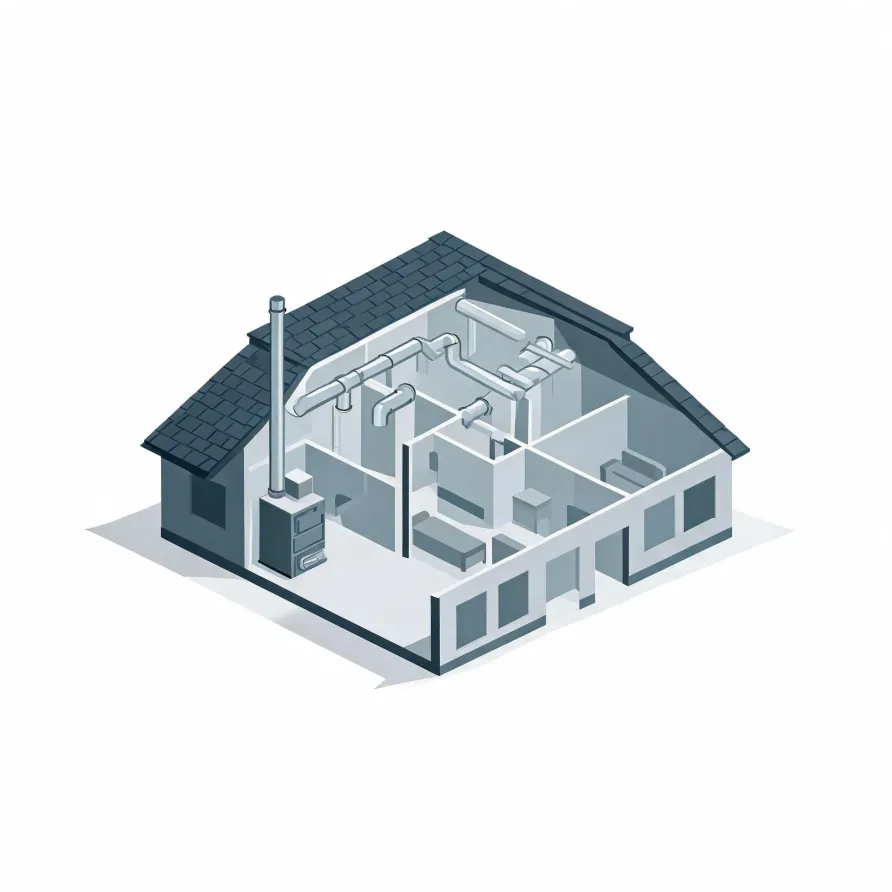
The furnace itself sits in a utility space, basement, or closet and is the first place a contractor looks when heat is missing or uneven. Inside it, the heat exchanger and burner assembly are the usual suspects: a cracked heat exchanger lets combustion gases into the airstream, and a failed burner or igniter means the fuel never lights in the first place.
The blower motor pulls air through the unit and pushes it out through the supply side. Alongside it, the limit switch, flame sensor, and control board each govern a specific stage of the heating cycle, and any one of them can shut the furnace down or cause it to short-cycle when it fails.
The drawing shows a typical furnace layout, and a licensed contractor determines which components apply to your specific system and what work they require.
Find a contractor in Butte CountyButte County, by the numbers
240 severe weather events were recorded in Butte County, Idaho between 2015 and 2024.
NOAA National Centers for Environmental Information, Storm Events Database, bulk CSV export, events 2015-01-01 through 2024-12-31.Half the homes in Butte County, Idaho were built in 1971 or earlier (2020-2024 ACS 5-year).
U.S. Census Bureau, 2020-2024 American Community Survey 5-Year EstimatesButte County, Idaho holds 1,336 housing units (2020-2024 ACS 5-year).
U.S. Census Bureau, 2020-2024 American Community Survey 5-Year EstimatesOwners occupy 77.5% of the occupied homes in Butte County, Idaho (2020-2024 ACS 5-year).
U.S. Census Bureau, 2020-2024 American Community Survey 5-Year EstimatesCodes & Standards Covering Furnace Repair in Butte County, Idaho5 sourced rules and standards
What happens when the contractor comes out
Non-weatherized gas furnaces manufactured on or after November 19, 2015 must reach 80.0 percent AFUE.
Non-weatherized oil-fired furnaces manufactured on or after November 19, 2015 must reach 83.0 percent AFUE.
Mobile home gas furnaces manufactured on or after November 19, 2015 must reach 80.0 percent AFUE.
Non-weatherized gas furnaces manufactured on or after December 18, 2028 must reach 95.0 percent AFUE, up from the 80.0 percent minimum that applies to units manufactured before that date.
Licensing Rules for HVAC Repair in Butte County, Idaho
Idaho requires a state certificate of competency for heating, ventilation and air conditioning work: it is unlawful to engage in the business, trade or practice without passing the examination and holding the certificate.
Weather Stress on HVAC Equipment in Butte County
Heating equipment works harder when outdoor conditions push toward extremes, and how often that happens here shapes how quickly components wear. Repair demand in Butte County follows the local climate, so understanding that pattern is part of understanding the service.
240 severe weather events, 2015–2024. Source: NOAA National Centers for Environmental Information, Storm Events Database.