Tell us about the job
Takes about a minute. No obligation.
A furnace repair in Idaho County starts with what the burner and heat exchanger have already been through. Homes in Idaho County, ID run heat about ten months a year, from September through June. That cycling loads the ignition system repeatedly, and cracks or carbon buildup in a heat exchanger are as likely to trace back to accumulated fatigue as to any single malfunction. A contractor here checks the combustion side carefully before pricing a repair, because the visible fault and the underlying cause are not always the same component.
Older ductwork and original furnace components tend to outlast the supply chains that once supported them. Half the homes in Idaho County, Idaho were built in 1977 or earlier (2020-2024 ACS 5-year). A contractor who opens a furnace in housing that old will often find that the part needing replacement has been discontinued, or that what is available now was not designed to the same specification. That changes the repair, sometimes to a rebuild around a compatible substitute, sometimes to a conversation about what is left to fix.
The Parts of a Furnace a Contractor Checks First
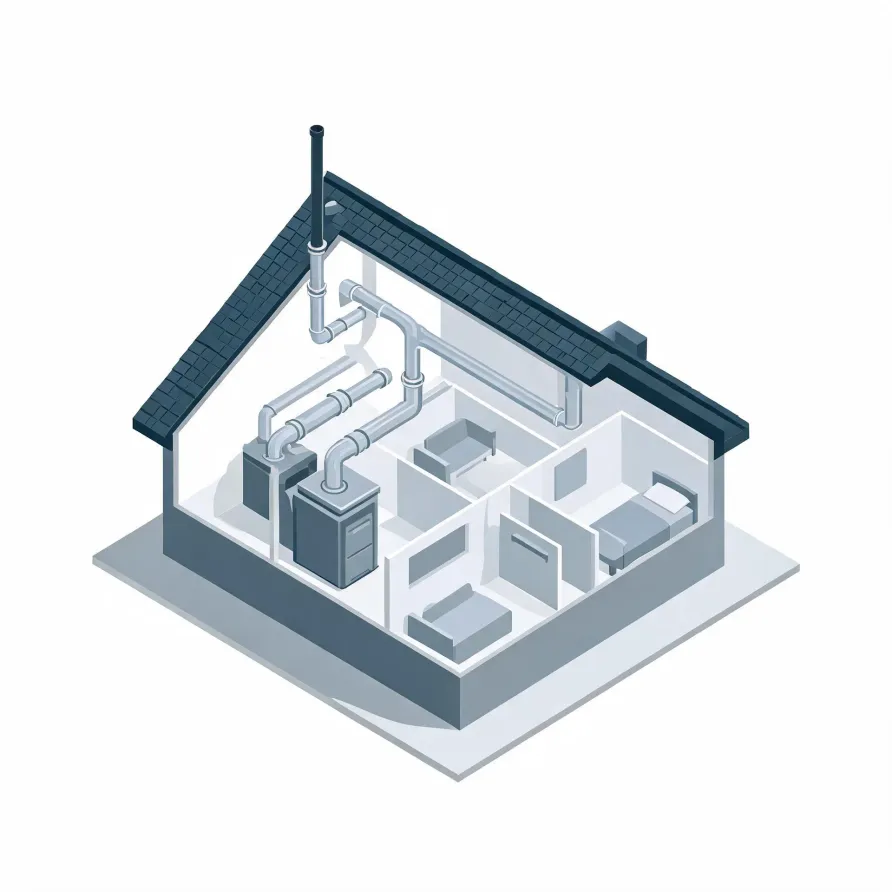
The furnace itself sits in a utility room, basement, or closet and is the unit that produces heat. Inside it, the heat exchanger is the first place a contractor looks when something is wrong. A cracked exchanger lets combustion gases into the living space. The burners, which sit just below it, are checked when the furnace short-cycles or fails to light.
The blower motor and its fan wheel sit at the base of the furnace cabinet and push conditioned air out through the supply side. The flue pipe runs from the top of the unit through the wall or roof and carries exhaust gases out. The control board governs the whole sequence, and when any component misbehaves, the board is often where a contractor reads the fault.
The drawing shows a typical furnace layout, and a licensed contractor determines which parts apply to your specific system and situation.
Find a contractor in Idaho CountyIdaho County, by the numbers
100 severe weather events were recorded in Idaho County, Idaho between 2015 and 2024.
NOAA National Centers for Environmental Information, Storm Events Database, bulk CSV export, events 2015-01-01 through 2024-12-31.Half the homes in Idaho County, Idaho were built in 1977 or earlier (2020-2024 ACS 5-year).
U.S. Census Bureau, 2020-2024 American Community Survey 5-Year EstimatesIdaho County, Idaho holds 8,903 housing units (2020-2024 ACS 5-year).
U.S. Census Bureau, 2020-2024 American Community Survey 5-Year EstimatesOwners occupy 80.9% of the occupied homes in Idaho County, Idaho (2020-2024 ACS 5-year).
U.S. Census Bureau, 2020-2024 American Community Survey 5-Year EstimatesCodes & Standards Governing Furnace Repair in Idaho County, Idaho5 sourced rules and standards
What Happens Once a Contractor Comes Out
Non-weatherized gas furnaces manufactured on or after November 19, 2015 must reach 80.0 percent AFUE.
Non-weatherized oil-fired furnaces manufactured on or after November 19, 2015 must reach 83.0 percent AFUE.
Mobile home gas furnaces manufactured on or after November 19, 2015 must reach 80.0 percent AFUE.
Non-weatherized gas furnaces manufactured on or after December 18, 2028 must reach 95.0 percent AFUE, up from the 80.0 percent minimum that applies to units manufactured before that date.
Licensing and Legal Requirements for HVAC Repair in Idaho County, Idaho
Idaho requires a state certificate of competency for heating, ventilation and air conditioning work: it is unlawful to engage in the business, trade or practice without passing the examination and holding the certificate.
Severe Weather Events in Idaho County
Idaho County's climate puts real stress on furnace components over time. How hard a system works, and how often it fails, tracks closely with what the weather demands of it.
100 severe weather events, 2015–2024. Source: NOAA National Centers for Environmental Information, Storm Events Database.