Tell us about the job
Takes about a minute. No obligation.
A contractor diagnosing a furnace repair in Lincoln County starts at the burner and heat exchanger before looking anywhere else. Homes in Lincoln County, ID run heat about nine months a year, from September through May. That length of continuous seasonal cycling puts real cumulative stress on the ignition system and the heat exchanger, where small cracks and carbon buildup develop gradually and go unnoticed until a cold morning forces a call. A furnace that has been short-cycling or running with a marginal igniter through repeated seasons will show that history in the metal.
Furnaces running in houses built for an earlier generation of equipment carry wear patterns a contractor reads from the components themselves, not from the age stamped on a permit. Half the homes in Lincoln County, Idaho were built in 1985 or earlier (2020-2024 ACS 5-year). That spread in the housing stock means a repair call here often lands on a parts question: what the opened system takes, and whether those parts are still in production. A heat exchanger or control board from a system that old can sit outside the current supply chain entirely, which is what turns a straightforward repair into a replacement conversation.
The Parts of a Furnace a Contractor Checks First
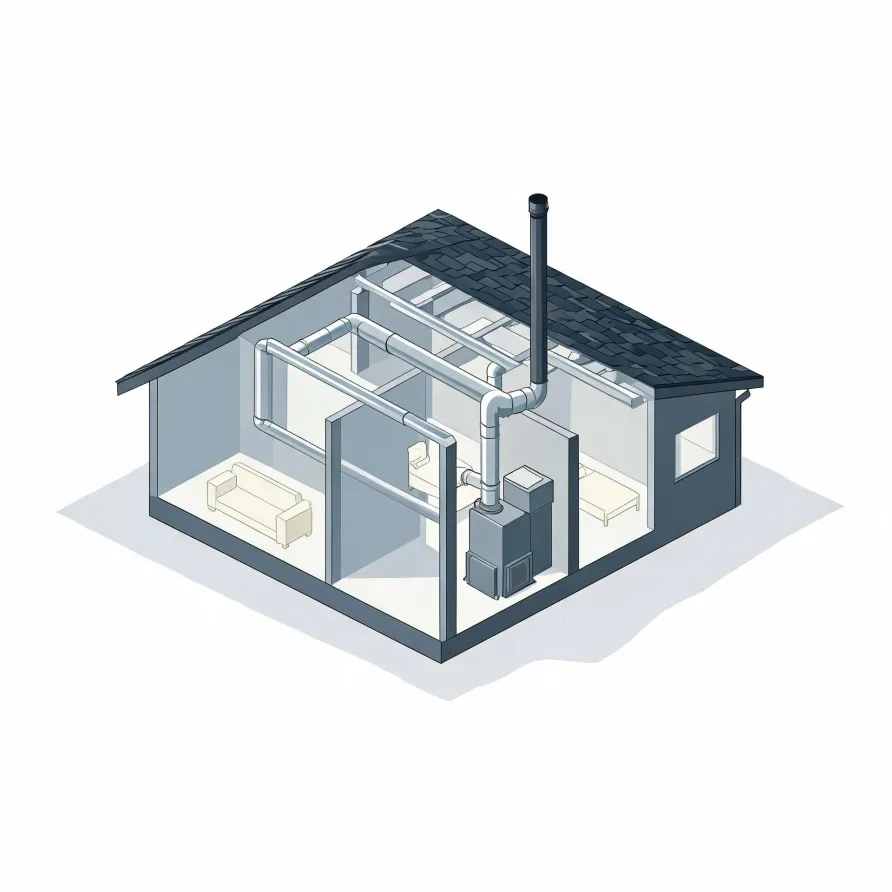
The furnace itself sits in a basement, utility closet, or garage and is the piece a contractor goes to first. Inside it, the heat exchanger is the part that fails silently and matters most: cracks there let combustion gases pass where they should not. The burners, igniter, and flame sensor all live inside that cabinet and are early targets when the furnace runs poorly or refuses to start.
The blower motor sits at the base of the furnace and pushes conditioned air into the duct system. Near it, the filter slot and the flue pipe that exits through the wall or roof both get checked, since a blocked filter starves the system and a compromised flue is a safety problem the contractor will not leave open.
The drawing shows a typical furnace layout, and a licensed contractor determines which of these components apply to your specific system and situation.
Find a contractor in Lincoln CountyLincoln County by the Numbers
29 severe weather events were recorded in Lincoln County, Idaho between 2015 and 2024.
NOAA National Centers for Environmental Information, Storm Events Database, bulk CSV export, events 2015-01-01 through 2024-12-31.Half the homes in Lincoln County, Idaho were built in 1985 or earlier (2020-2024 ACS 5-year).
U.S. Census Bureau, 2020-2024 American Community Survey 5-Year EstimatesLincoln County, Idaho holds 1,989 housing units (2020-2024 ACS 5-year).
U.S. Census Bureau, 2020-2024 American Community Survey 5-Year EstimatesOwners occupy 78.9% of the occupied homes in Lincoln County, Idaho (2020-2024 ACS 5-year).
U.S. Census Bureau, 2020-2024 American Community Survey 5-Year EstimatesCodes & Standards Governing Furnace Repair in Lincoln County, Idaho5 sourced rules and standards
What HVAC Repair Looks Like in Lincoln County
Non-weatherized gas furnaces manufactured on or after November 19, 2015 must reach 80.0 percent AFUE.
Non-weatherized oil-fired furnaces manufactured on or after November 19, 2015 must reach 83.0 percent AFUE.
Mobile home gas furnaces manufactured on or after November 19, 2015 must reach 80.0 percent AFUE.
Non-weatherized gas furnaces manufactured on or after December 18, 2028 must reach 95.0 percent AFUE, up from the 80.0 percent minimum that applies to units manufactured before that date.
Licensing and Legal Requirements in Lincoln County, Idaho
Idaho requires a state certificate of competency for heating, ventilation and air conditioning work: it is unlawful to engage in the business, trade or practice without passing the examination and holding the certificate.
Severe Weather Events in Lincoln County
Heating equipment works harder and wears faster when outdoor conditions are extreme. How much stress a furnace carries over its life is a local fact, shaped by what the weather in Lincoln County actually does.
29 severe weather events, 2016–2024. Source: NOAA National Centers for Environmental Information, Storm Events Database.