Tell us about the job
Takes about a minute. No obligation.
A furnace in Camas County earns its repairs the hard way. Homes in Camas County, ID run heat about ten months a year, from September through June. The burner, the heat exchanger, and the ignition system cycle through that load season after season, and those are the components a contractor opens first when something breaks. An igniter that has fired thousands of times over consecutive winters tells a clearer story than the age of the unit itself. Cracks in the heat exchanger, carbon buildup at the burner ports, and ignition failures all trace back to accumulated cycling, and a contractor doing repair work here expects to find that wear concentrated in those parts.
Furnaces in houses like these have often outlasted the systems they replaced, and what a contractor finds once the unit is open decides everything about the repair scope. Half the homes in Camas County, Idaho were built in 1991 or earlier (2020-2024 ACS 5-year). That gap between when a house was built and what is running in it now means heat exchangers, burner assemblies, and flue connections have histories behind them that only opened equipment reveals clearly. Parts from that era are not always in current supply, which changes whether a repair is a straight parts swap or something more involved.
The Parts of a Furnace a Contractor Checks First
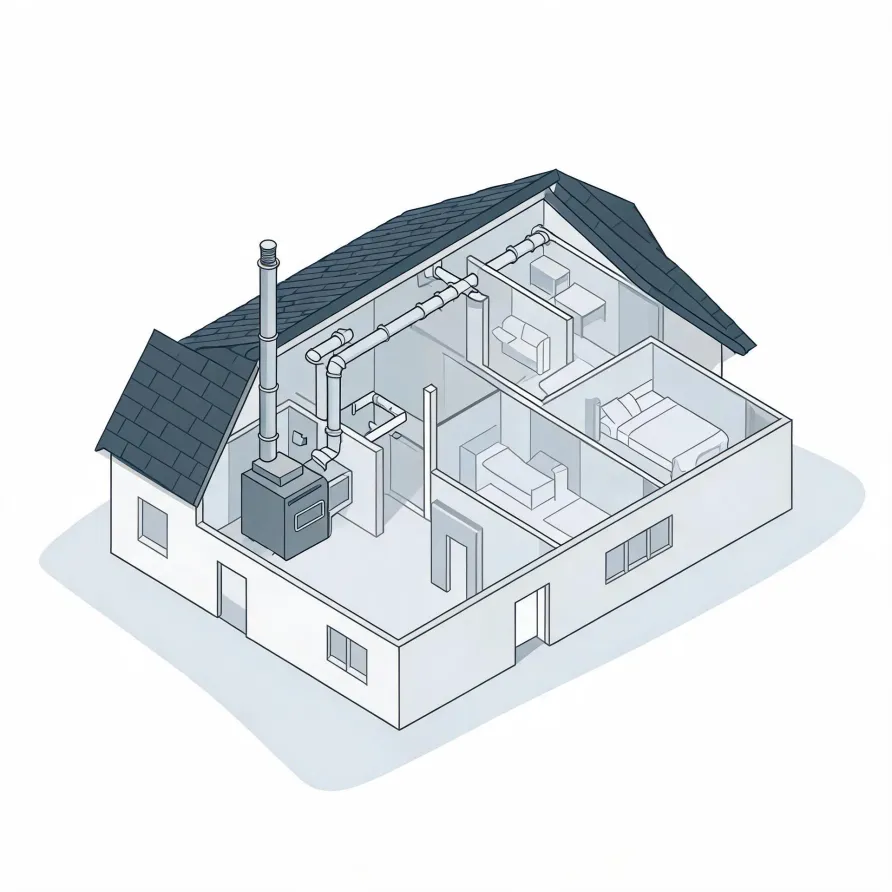
The furnace itself sits in a basement, utility closet, or garage and is where heat gets made. Inside it, the heat exchanger is the piece a contractor looks at early: cracks or buildup there are a common source of heating failure. The burners, which fire inside that exchanger, are another first stop when a furnace runs poorly or not at all.
The blower motor sits at the base of the furnace and pushes conditioned air into the duct system. Near it, the limit switch and control board govern when the burners fire and when the blower runs. When a furnace short-cycles, runs constantly, or refuses to start, those components are where a contractor traces the fault.
The drawing shows a representative layout, and a licensed contractor determines which parts and conditions apply to your specific system.
Find a contractor in Camas CountyCamas County, by the record
63 severe weather events were recorded in Camas County, Idaho between 2015 and 2024.
NOAA National Centers for Environmental Information, Storm Events Database, bulk CSV export, events 2015-01-01 through 2024-12-31.Half the homes in Camas County, Idaho were built in 1991 or earlier (2020-2024 ACS 5-year).
U.S. Census Bureau, 2020-2024 American Community Survey 5-Year EstimatesCamas County, Idaho holds 703 housing units (2020-2024 ACS 5-year).
U.S. Census Bureau, 2020-2024 American Community Survey 5-Year EstimatesOwners occupy 80.0% of the occupied homes in Camas County, Idaho (2020-2024 ACS 5-year).
U.S. Census Bureau, 2020-2024 American Community Survey 5-Year EstimatesCodes & Standards Governing Furnace Repair in Camas County, Idaho5 sourced rules & standards
What Happens When the Contractor Comes Out
Non-weatherized gas furnaces manufactured on or after November 19, 2015 must reach 80.0 percent AFUE.
Non-weatherized oil-fired furnaces manufactured on or after November 19, 2015 must reach 83.0 percent AFUE.
Mobile home gas furnaces manufactured on or after November 19, 2015 must reach 80.0 percent AFUE.
Non-weatherized gas furnaces manufactured on or after December 18, 2028 must reach 95.0 percent AFUE, up from the 80.0 percent minimum that applies to units manufactured before that date.
Licensing Rules for HVAC Repair in Camas County, Idaho
Idaho requires a state certificate of competency for heating, ventilation and air conditioning work: it is unlawful to engage in the business, trade or practice without passing the examination and holding the certificate.
Weather Patterns Driving HVAC Demand in Camas County, Idaho
Extreme weather puts real strain on furnaces, forcing them to run harder and longer than they were sized to handle. How much strain depends on where you live, and Camas County has its own record.
63 severe weather events, 2015–2024. Source: NOAA National Centers for Environmental Information, Storm Events Database.