Tell us about the job
Takes about a minute. No obligation.
Sizing a furnace for a Latah County home is not a calculation a contractor can borrow from another region and adjust later. Homes in Latah County, ID run heat about ten months a year, from September through June. The burner and heat exchanger carry that load through almost every month, which means a system that is undersized or poorly sealed at installation accumulates wear on its cycling components faster than the homeowner sees it coming. A qualified contractor runs a full load calculation before quoting anything, because the local heating demand is what determines which unit belongs in that house.
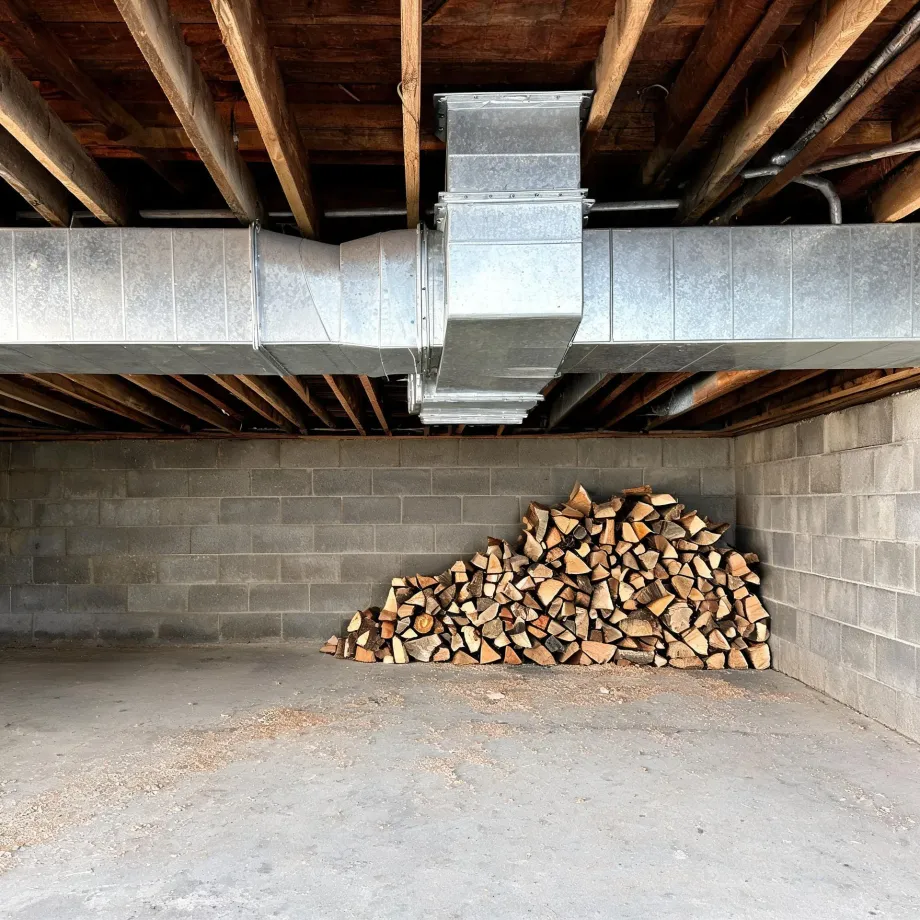
Ductwork sized for a system that is no longer in the house does not automatically carry what a contractor puts in its place. Half the homes in Latah County, Idaho were built in 1980 or earlier (2020-2024 ACS 5-year). That means the existing trunk lines, branch runs, and returns in a large share of Latah County homes were engineered around equipment that predates what a contractor is now being asked to install. Before a new furnace can be matched to the house rather than just fitted to the opening, a contractor has to assess whether what is already in the walls moves the right volume of air through the right paths for the new unit's output.
What Gets Installed With a New Furnace
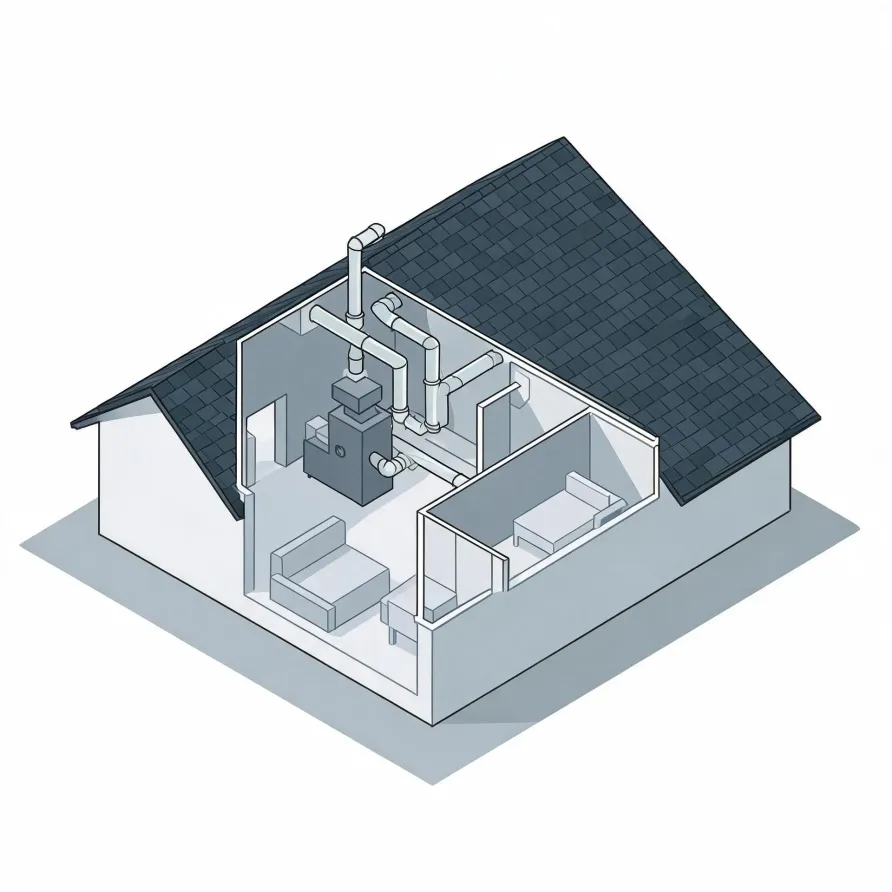
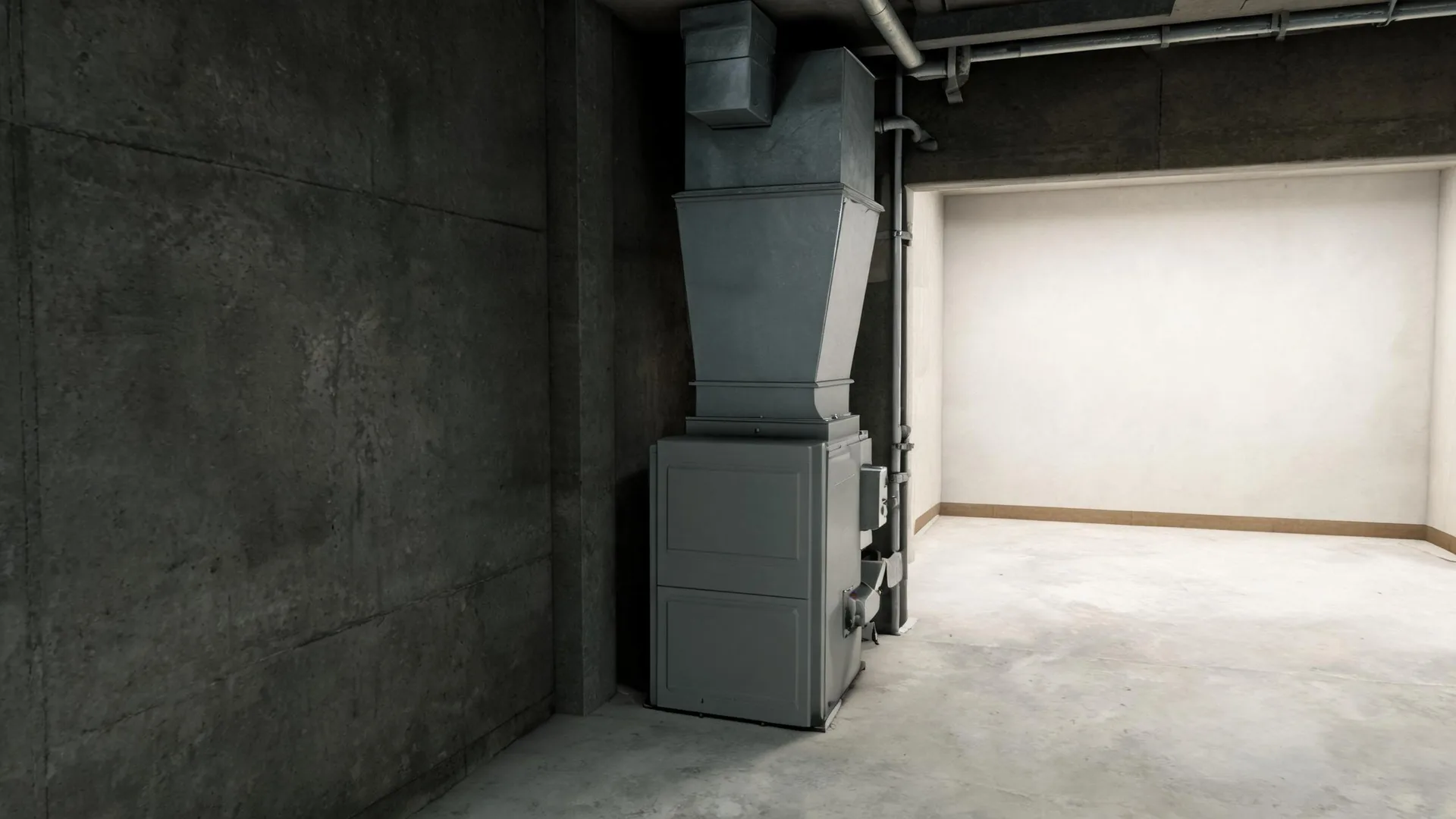
The furnace itself sits in the basement, utility room, or closet and is the unit a homeowner sees first. Inside it, the heat exchanger, burner assembly, and blower motor each occupy a fixed position. The heat exchanger runs down the center of the cabinet, the burner assembly sits beneath it, and the blower motor occupies the lower compartment.
The flue pipe exits the furnace cabinet and runs to an exterior wall or up through the roof, carrying combustion gases out of the house. The thermostat mounts on an interior wall and serves as the control point for the whole system. The filter housing sits at the return-air opening where air enters the furnace.
The drawing shows a representative layout, and a licensed contractor determines exactly what applies to this house.
Find a contractor in Latah CountyLatah County by the Numbers
278 severe weather events were recorded in Latah County, Idaho between 2015 and 2024.
NOAA National Centers for Environmental Information, Storm Events Database, bulk CSV export, events 2015-01-01 through 2024-12-31.Half the homes in Latah County, Idaho were built in 1980 or earlier (2020-2024 ACS 5-year).
U.S. Census Bureau, 2020-2024 American Community Survey 5-Year EstimatesLatah County, Idaho holds 17,591 housing units (2020-2024 ACS 5-year).
U.S. Census Bureau, 2020-2024 American Community Survey 5-Year EstimatesOwners occupy 58.7% of the occupied homes in Latah County, Idaho (2020-2024 ACS 5-year).
U.S. Census Bureau, 2020-2024 American Community Survey 5-Year EstimatesCodes & Standards Governing Furnace Installation in Latah County, Idaho5 sourced rules & standards
What happens when the contractor arrives
Non-weatherized gas furnaces manufactured on or after November 19, 2015 must reach 80.0 percent AFUE.
Non-weatherized oil-fired furnaces manufactured on or after November 19, 2015 must reach 83.0 percent AFUE.
Mobile home gas furnaces manufactured on or after November 19, 2015 must reach 80.0 percent AFUE.
Non-weatherized gas furnaces manufactured on or after December 18, 2028 must reach 95.0 percent AFUE, up from the 80.0 percent minimum that applies to units manufactured before that date.
Licensing Rules for Contractors in Latah County, Idaho
Idaho requires a state certificate of competency for heating, ventilation and air conditioning work: it is unlawful to engage in the business, trade or practice without passing the examination and holding the certificate.
Severe Weather Events in Latah County
Latah County weather puts real demands on residential heating equipment, and those demands shape what a furnace installation here needs to handle. What holds up in a mild climate may fall short in a harder one, which is why local weather history is part of the picture.
278 severe weather events, 2015–2024. Source: NOAA National Centers for Environmental Information, Storm Events Database.