Tell us about the job
Takes about a minute. No obligation.
Homes in Elmore County, ID run heat about ten months a year, from September through June. The burner and ignition system on a furnace cycle through that whole stretch, and the heat exchanger flexes with every firing. A contractor coming out for a repair checks those parts first, because they carry the load while the rest of the house equipment sits idle. Wear on the igniter or cracks in the exchanger are not surprises here; they are the predictable result of a burner that almost never stops.
Furnaces in older housing tend to be replaced once or twice over a house's lifetime, which means the unit a contractor opens today is probably not the original one. Half the homes in Elmore County, Idaho were built in 1988 or earlier (2020-2024 ACS 5-year). What that history produces on a repair call is a system whose heat exchanger, igniter, or control board may be a generation behind current production, and where a parts search is part of the job. If the component is still made, the repair moves forward. If it is not, the contractor and homeowner are deciding between fabrication, substitution, or replacement before the work scope is set.
The Parts of a Furnace a Contractor Checks First
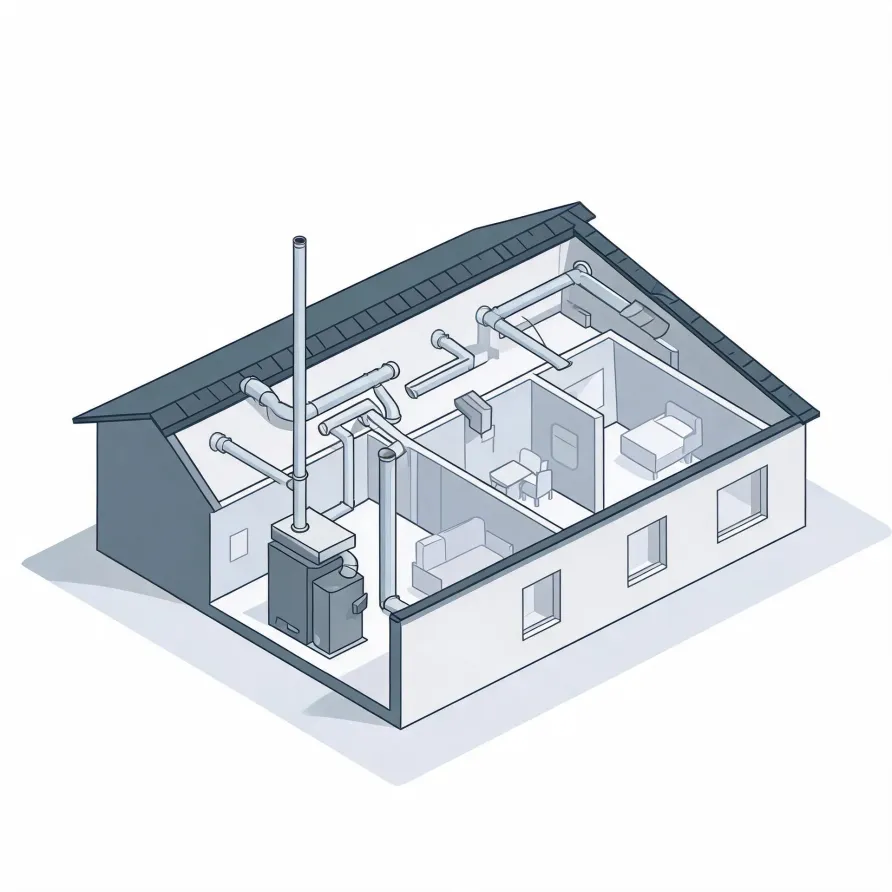
The furnace itself sits in a basement, utility closet, or garage and is the piece a contractor goes to first. Inside it, the heat exchanger is the part that fails in ways a homeowner feels fast: cracks there let combustion gases enter the living space, and a failed blower motor inside the same cabinet means conditioned air stops moving entirely.
The flue pipe runs from the furnace up and out of the house, carrying exhaust gases away, and a blockage or breach there is a common source of carbon monoxide problems. The thermostat on the wall and the gas valve inside the cabinet are both controls a contractor tests early, since either one can mimic a much larger failure.
The drawing shows the general layout of a furnace system, and a licensed contractor determines what applies to this particular house.
Find a contractor in Elmore CountyElmore County, by the numbers
126 severe weather events were recorded in Elmore County, Idaho between 2015 and 2024.
NOAA National Centers for Environmental Information, Storm Events Database, bulk CSV export, events 2015-01-01 through 2024-12-31.Half the homes in Elmore County, Idaho were built in 1988 or earlier (2020-2024 ACS 5-year).
U.S. Census Bureau, 2020-2024 American Community Survey 5-Year EstimatesElmore County, Idaho holds 12,271 housing units (2020-2024 ACS 5-year).
U.S. Census Bureau, 2020-2024 American Community Survey 5-Year EstimatesOwners occupy 65.6% of the occupied homes in Elmore County, Idaho (2020-2024 ACS 5-year).
U.S. Census Bureau, 2020-2024 American Community Survey 5-Year EstimatesCodes & Standards Behind Furnace Repair in Elmore County, Idaho5 sourced rules & standards
What happens when the contractor shows up
Non-weatherized gas furnaces manufactured on or after November 19, 2015 must reach 80.0 percent AFUE.
Non-weatherized oil-fired furnaces manufactured on or after November 19, 2015 must reach 83.0 percent AFUE.
Mobile home gas furnaces manufactured on or after November 19, 2015 must reach 80.0 percent AFUE.
Non-weatherized gas furnaces manufactured on or after December 18, 2028 must reach 95.0 percent AFUE, up from the 80.0 percent minimum that applies to units manufactured before that date.
Licensing Rules for HVAC Repair in Elmore County, Idaho
Idaho requires a state certificate of competency for heating, ventilation and air conditioning work: it is unlawful to engage in the business, trade or practice without passing the examination and holding the certificate.
Severe Weather Events in Elmore County
Hard weather puts real hours on heating equipment. Furnaces that run harder and longer to hold indoor temperatures against the cold take the kind of wear that shows up as repair calls, and that pattern is local to Elmore County.
126 severe weather events, 2015–2024. Source: NOAA National Centers for Environmental Information, Storm Events Database.