Tell us about the job
Takes about a minute. No obligation.
Furnace repairs in Bannock County start with the parts that actually cycle: the burner, the heat exchanger, and the ignition system. Homes in Bannock County, ID run heat about ten months a year, from September through June. A furnace working through that kind of season puts repeated thermal stress on the heat exchanger every time it fires and cools, and the ignition system earns its failures one start at a time. When a contractor quotes a repair here, they look at those components first, because the wear accumulates where the cycling is.
Furnaces in older housing stock accumulate a repair history that the nameplate on the current unit does not show. Half the homes in Bannock County, Idaho were built in 1976 or earlier (2020-2024 ACS 5-year). A heat exchanger cracked by repeated thermal stress, a burner assembly scaled from decades of mineral-laden air, a flue connection patched by a previous technician and left: these are what a contractor finds when the unit is open, and they are what determines whether a repair is straightforward or whether the scope widens. Parts availability for systems running in houses this age varies by manufacturer and model, so a contractor prices the repair from what the opened unit actually contains, not from the model number alone.
The Parts of a Furnace a Contractor Checks First
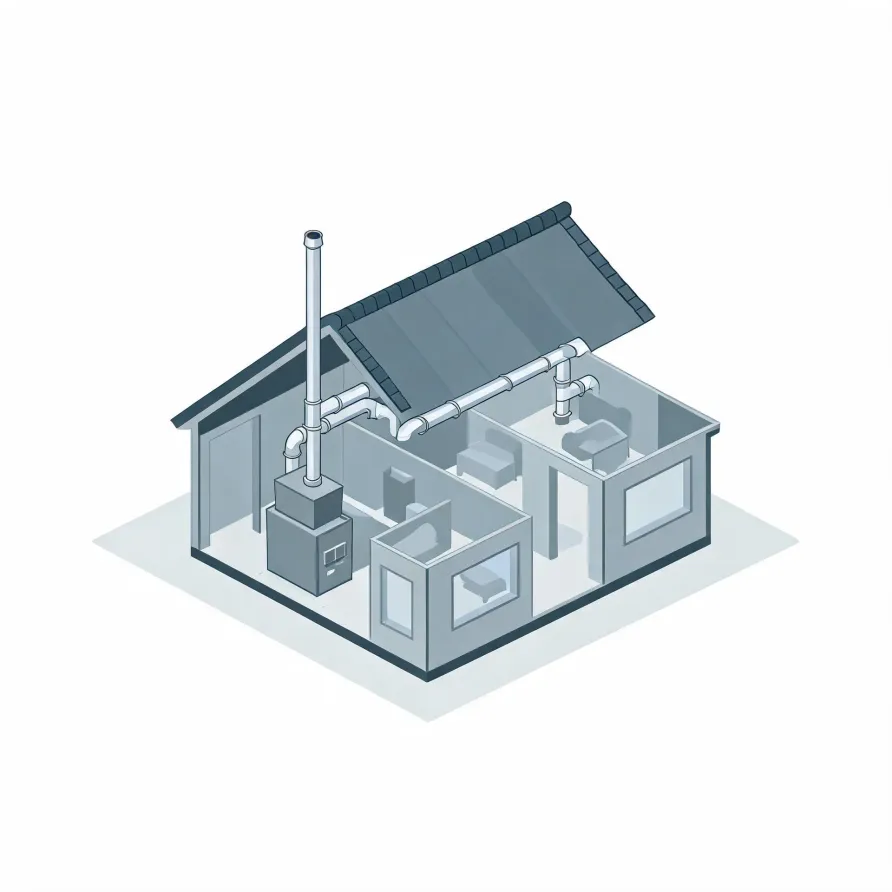
The furnace itself sits in a utility room, basement, or closet and is the heart of the system. Inside it, the heat exchanger does the work of warming air, and a cracked or corroded exchanger is one of the first things a contractor looks for when the unit is running poorly or cycling off too soon. The burners, which fire inside that exchanger, are another early stop.
The blower motor pulls air through the system and pushes it outward once warmed. A failing motor shows up as weak airflow or unusual noise from the cabinet. Alongside it, the inducer motor and the control board each govern how the furnace starts and runs, and both are common sources of fault codes when the system stops responding correctly.
The drawing shows a typical furnace layout, and a licensed contractor will determine which components apply to the setup in your home.
Find a contractor in Bannock CountyBannock County, by the numbers
149 severe weather events were recorded in Bannock County, Idaho between 2015 and 2024.
NOAA National Centers for Environmental Information, Storm Events Database, bulk CSV export, events 2015-01-01 through 2024-12-31.Half the homes in Bannock County, Idaho were built in 1976 or earlier (2020-2024 ACS 5-year).
U.S. Census Bureau, 2020-2024 American Community Survey 5-Year EstimatesBannock County, Idaho holds 36,168 housing units (2020-2024 ACS 5-year).
U.S. Census Bureau, 2020-2024 American Community Survey 5-Year EstimatesOwners occupy 69.5% of the occupied homes in Bannock County, Idaho (2020-2024 ACS 5-year).
U.S. Census Bureau, 2020-2024 American Community Survey 5-Year EstimatesCodes & Standards Covering Furnace Repair in Bannock County, Idaho5 sourced rules and standards
What to Expect From the Repair Visit
Non-weatherized gas furnaces manufactured on or after November 19, 2015 must reach 80.0 percent AFUE.
Non-weatherized oil-fired furnaces manufactured on or after November 19, 2015 must reach 83.0 percent AFUE.
Mobile home gas furnaces manufactured on or after November 19, 2015 must reach 80.0 percent AFUE.
Non-weatherized gas furnaces manufactured on or after December 18, 2028 must reach 95.0 percent AFUE, up from the 80.0 percent minimum that applies to units manufactured before that date.
Licensing Rules for HVAC Work in Bannock County, Idaho
Idaho requires a state certificate of competency for heating, ventilation and air conditioning work: it is unlawful to engage in the business, trade or practice without passing the examination and holding the certificate.
Weather Events in Bannock County That Put Heating Systems to Work
Bannock County weather shapes how hard a furnace has to work and how often something inside it fails. A chart of recorded severe weather events shows the load this area puts on heating equipment, which is part of why furnace repair here is a local trade, not a generic one.
149 severe weather events, 2015–2024. Source: NOAA National Centers for Environmental Information, Storm Events Database.